Making Art from Thrash
There are no cars parked in Steve Duque's garage.
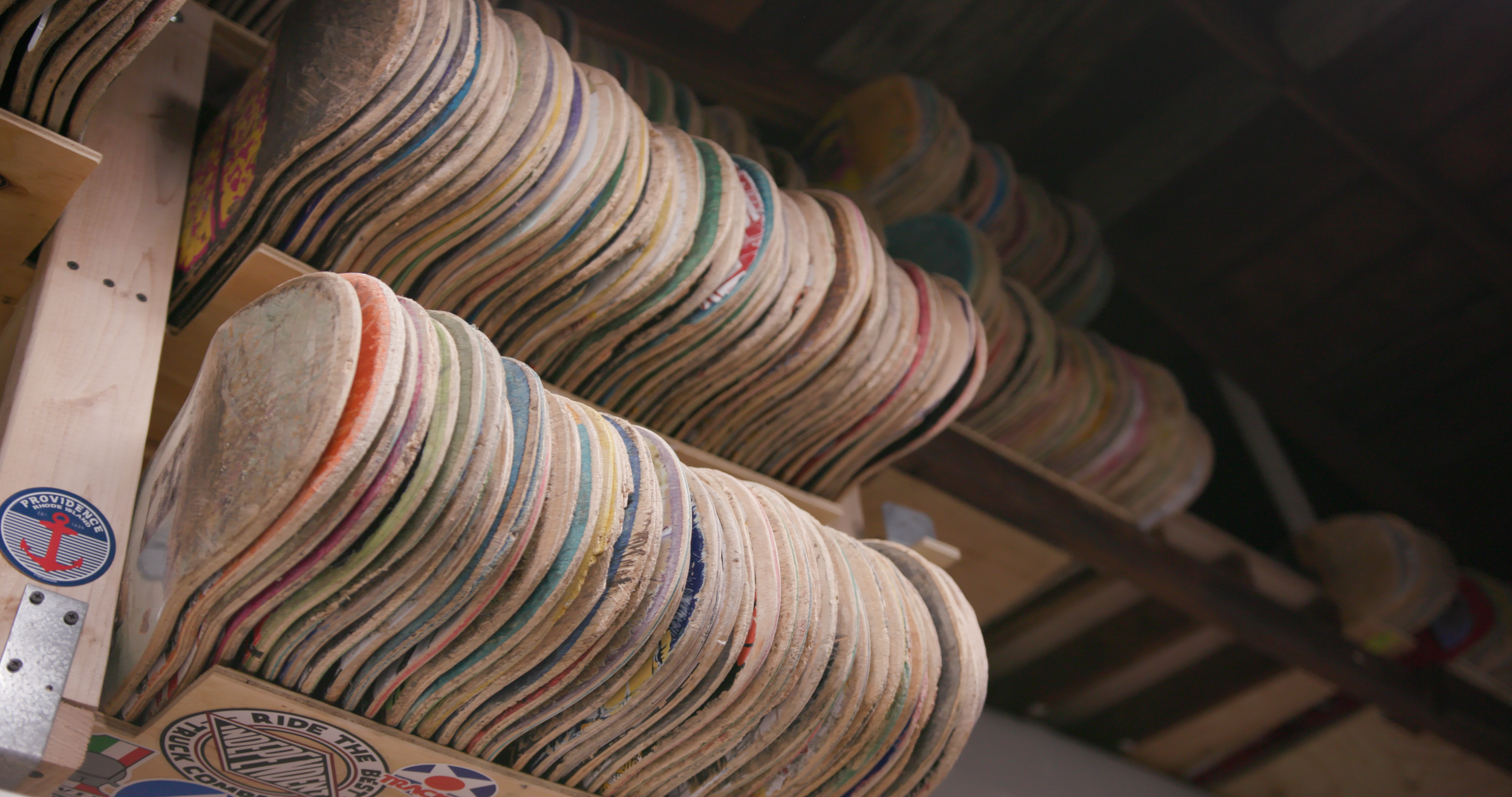
Cabinets, tables, and workbenches lining the walls are topped by woodworking tools and the typical flotsam of a workshop. A fine coating of multicolored dust covers work surfaces, bicycles, and the other artifacts of life one stores in a garage. In every nook and cranny, impossible not to notice is the source of all that dust: broken skateboards, fragments of broken skateboards, and particles of what could appear to have once been a skateboard. Hundreds of boards line the ceiling. Piles of boards cracked in half are stuffed into any available free space. Atop the workbench sits a neat stack of tails, or perhaps noses -- it's hard to tell the difference at a glance. A precarious pile of parts on a step ladder waits to be glued up into a bowl blank. Tiny strips and bits dot every flat surface. All of this technicolor chaos caused by Steve's material of choice: skateboards.
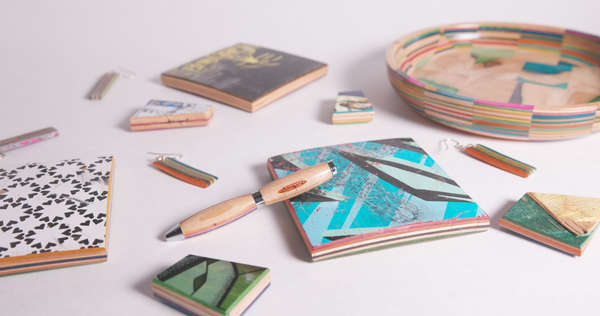
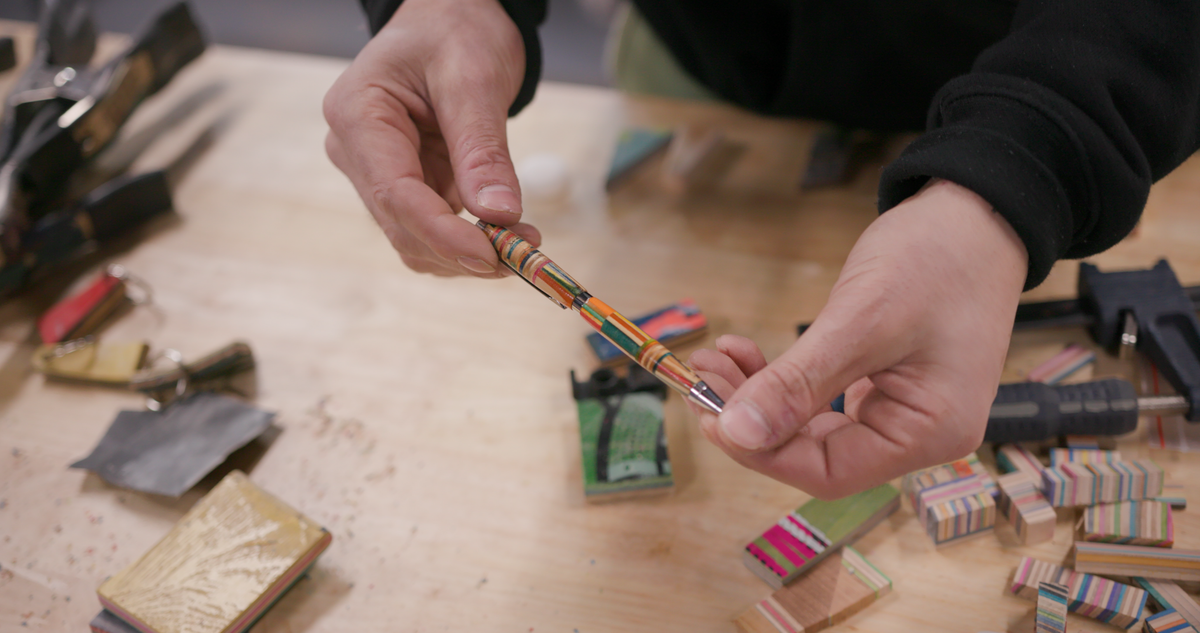
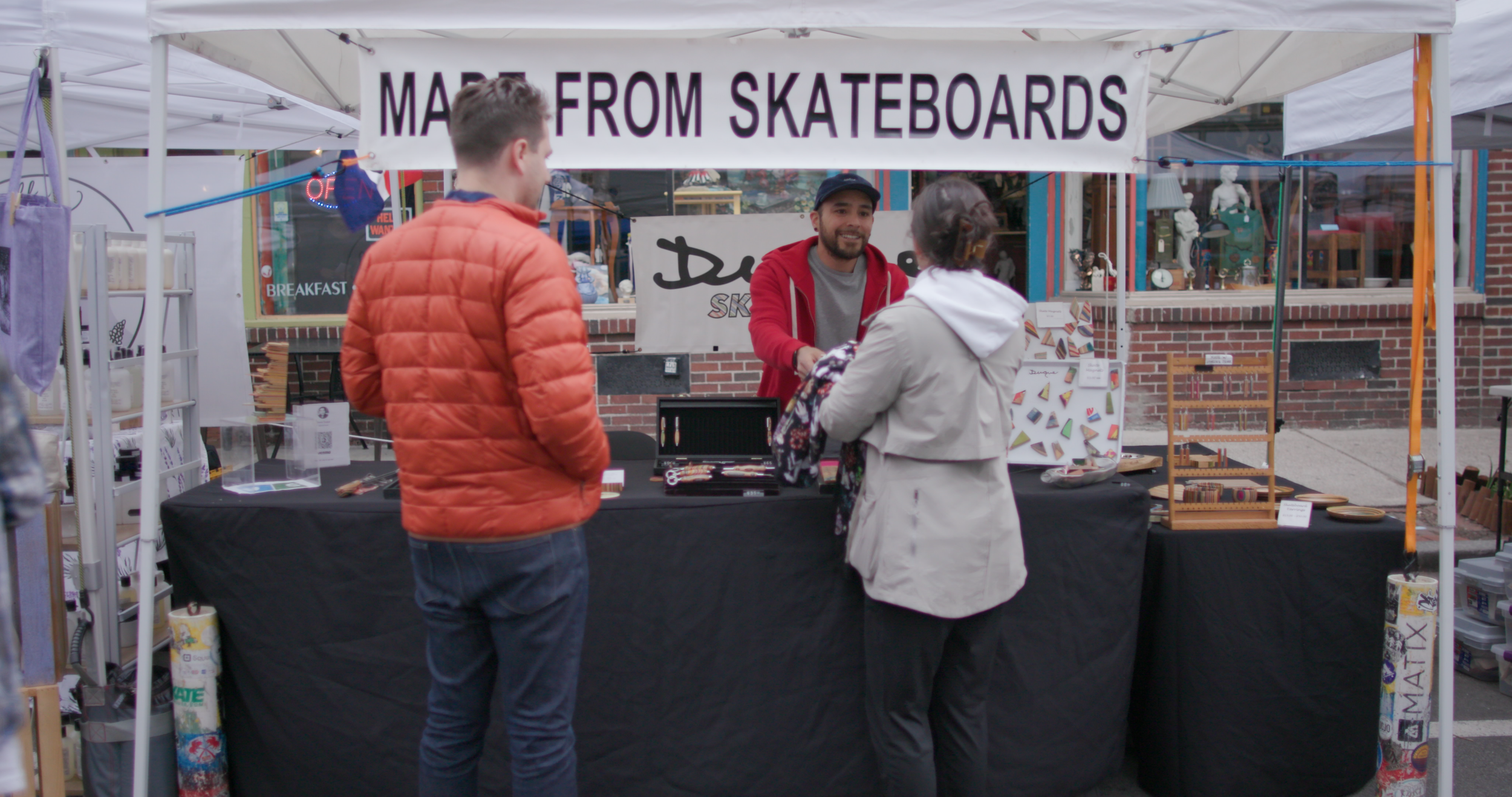
Born and raised in Rhode Island, artist Steve Duque transforms broken skateboards into functional objects. Duque Skate Art is the business, but business wasn't always the plan. In the early 2010's, inspired by a documentary by Janne Saario, Steve tried his hand at some skateboard art of his own. From the beginning artistic pursuit was front and center, but practical application of the material seemed inevitable. A broken napkin holder sat on his table while he was working on his first project. "I can fix that with these pieces of skateboard," he thought to himself. And so he did. Cut some strips of board, glue them together, affix to the napkin holder. This simple, practical act revealed the potential that skateboards as a material could hold. Eventually he would make more objects: a magnet, key chains, earrings, pens. Steve brought the first pen he made to his day job to share with his coworkers. "They were stoked."
The backstory of a skateboard directly impacts on what it becomes in Steve's workshop. How a tree in the Canadian wilderness lived and grew. A worker's attention in the handful of woodshops that actually make the blank boards. The journey to get a finished board to a store. The display in a window by a local skate shop in just the right way that a little kid begs their dad for it. Dad gives in. She rides it hard, she's learning, but the board can take it. There's only so much damage an 8 year old little girl can do. So she rides, grows older, and loses interest. The skateboard is then relegated to collecting dust until a yard sale.
When Steve finally obtains a skateboard, its physical condition limits its utility. Some boards are so far gone they are only good for small inch-sized magnets, while others are brand new and have much more potential. The pieces Steve creates are therefore entirely unique. No two boards are made, or used, in the exact same way. Skateboards take on the personality of their riders. These unique qualities of skateboards are favorable to Steve. "I want every piece unique," he says. "So that no two people are walking around with the same thing."
In American Craft's Spring 2023 issue, which focused on vessels, there was an idea that is embodied in Steve's work: objects are vessels for memories. We fill them up, they get emptied, perhaps leak or spill, and we fill them up again. We share our cups and ensure that the person it's passed to next has a little room to add their own memories. A skateboard's scars share it's story and the story of its rider. Objects evolve over time and at some point there is a major jump, an inventiveness or breakthrough that stands out. Changing the value proposition of an object through physical modification is an obvious evolutionary force.
One man's trash is another man's treasure is a truism about value. A statement about how we value things, objects, and possessions, and what happens when values change. Waste is a human construction -- the natural world doesn't have waste. Everything is used in some form. We consider something waste when it no longer provides us with value. Be it monetary or emotional value. To Steve, broken skateboards aren't trash. They may not rise to the superlative of treasure, but there's potential waiting to be actualized. Potential that Steve has the ability to bring out.
"Where do you get the boards from?" is the number one question Steve gets, and his answer is always the same, "Where ever I can." Steve loves searching and finding skateboards. The hunt for new colors and unique color combinations is exciting. Steve has thousands of boards, he doesn't need more, but still he searches. For some of the boards in his collection Steve can recall their provenance, but there are still hundreds where he has no idea. Regardless the process is always the same: combine boards and colors until something new is made. One mystery board thrashed beyond recognition combined with a friend's cherished childhood board into a new thing. A new thing to be appreciated and accumulate it's own story. Through multiple physical transformations and the gathering and shedding of contexts Steve creates collages of value and meaning. Steve is removing the skateboard from its original context, which creates a new but familiar form. The evidence of the skateboard's past life is present in the necessary modifications of the material, the scratches and dents, and in the appearance and color.
Corinna Gardner, Acting Keeper of the Victoria and Albert Museum’s Design, Architecture, and Digital department in London in discussing the addition of the Pussy Hat to the museum's collection said, "We see each object as a node, a material thing around which we can focus the bigger questions that bespeak how you and I live together, today and in the future." When Steve comes across one of these boards in the wild, he has no idea where it came from, or what its story is or where that story is going. He does know that the story doesn't end there in the gutter by a skate park. Or gathering dust in an empty nester's basement. It's his little part in making the world, his community, and the state of Rhode Island, a better place.
Watch the full profile documentary on Steve Duque